2014-01-29
Trade Wars 2002 contest starting Feb. 1
HiR is hosting a TW2002 contest. Fire up your telnet clients, pick a throwaway password you'll never use for anything else, and join us.
The contest game (Game B) is a TW2002 Gold game with very few modifications, a 5,000 sector universe and 1,000 turns per day. 5 deaths eliminates you. The contest opens on February 1st, with a 14 day entry window. No admittance after that. No prizes other than bragging rights, but it should be fun.
In the meantime, a sandbox (Game A) is in session for your amusement and a bit of practice. It offers 5,000 turns per day to really give you a lot of time to explore and get your bearings straight with how the game works. I'm sure some of you are kind of rusty. I'll probably reset it in about two weeks when the entry period for the contest game closes.
You can get to the games via telnet on tw2002.h-i-r.net port 2002/tcp
All of the "Forgotten Ages" verbiage is a hold-over from the telnet MUD/BBS my wife ran back in the early 2000s. We've had licenses for Trade Wars and TWGS for a long time, and decided to finally put them to use.
Play clean, or play dirty. There are a lot of glitches and loopholes in this relic of a game. They're yours to use if you can find them.
2010-05-04
Conspiracy Theory: A Battle.net security shill?
A few days ago, my wife logged in to World Of Warcraft only to find that all of her characters had been pretty much stripped of everything. Her username isn't related to any of her mail or social media accounts, and her passwords are unique between all her various accounts. Her WoW password wasn't easy to guess by a long shot, and complex enough that I doubt it was brute forced.
Labels: conspiracy, games, InfoSec
2009-01-11
One for the Role Playing Gamers
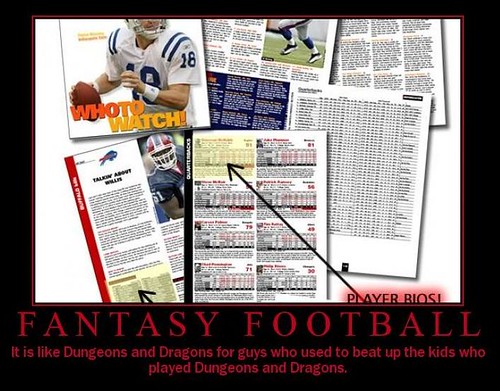
Both Frogman and (jeff)isageek shared these RPG Motivational Posters on Geekdad via Google Reader today. This one is my favorite.
2008-12-14
Exploiting in-game logic flaws
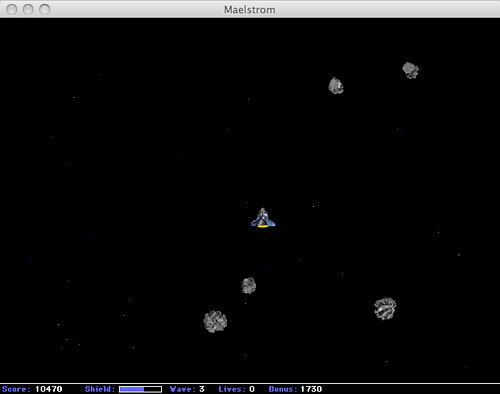
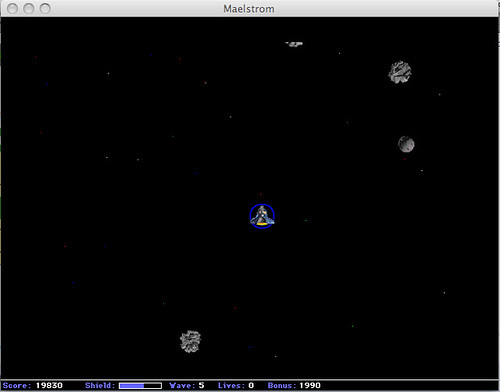
Another one of my favorite games of days gone by is Maelstrom. I first discovered this my sophomore year of high school. Someone had installed it on quite a few Macs in the computer lab. It's a 3D-looking Asteroids rip-off. When I finally built my first Linux system for home use in the mid-90s, this was one of the first games I found that worked well. It had been open-sourced.
It's got all the features you'd expect of an Asteroids clone: Shields, UFOs that shoot at you from time to time, and... asteroids. There are also comets (shoot for more bonus points), surprise packages (catch them with your ship to get different weapons or other surprises, some good, some bad), metal asteroids you can't destroy, and the occasional black hole (or Maelstrom, if you will)
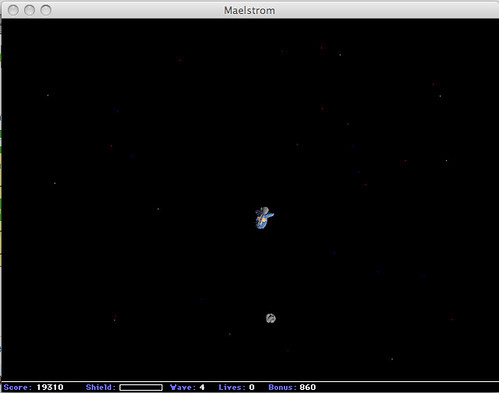
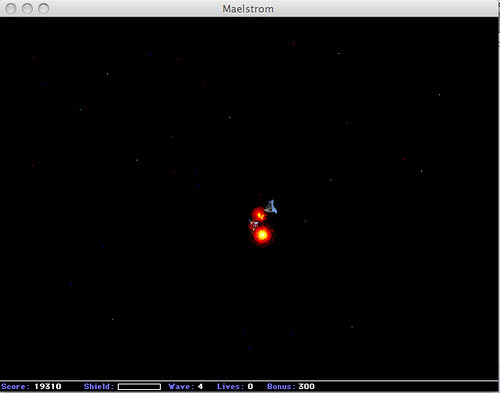
One thing I noticed early on, is that if you ever blow your ship up on the last asteroid, you don't actually lose a life, but any special weapons you have will go away.
But, if you look, your shields get replenished back to new when you start the next wave (level)
This happened because there are some logic problems at play. Primarily, the logic to reduce your lives by 1 (or to end the game if you're at 0 like I was) does not run as part of the block of code that initializes the ship's options to default when it's struck, and is somehow missed because of the end of a level. Was it intentional? I have no idea without checking the source code. It's always possible stuff like this is actually an easter egg.
This is the kind of bug that slips through the cracks and is only noticeable during code audits or caught with fuzzing or other black-box testing methods. Often, by invoking conditions that happen rarely, you can get unexpected results. If you can leverage those conditions to happen easily, you can reproduce the results as frequently as you wish. In Maelstrom, it's as simple as sacrificing your ship to knock out that last asteroid, knowing you'll get rewarded with shields for the next round. The same applies to operating systems, the firmware running on your mobile phone and cable box, and pretty much anything else that's been programmed by a human.
Have you found any little game bugs worth exploiting?
2008-12-12
More OpenArena Fun
First and foremost, this is just a concept, but L3DGEworld is an OpenArena-based visualization platform for network hosts. Currently, the main info-gathering daemon (Greymatter) only supports FreeBSD. I tried compiling it on OpenBSD and the code doesn't quite get along with OBSD's C Compiler. Fakematter, the demonstration daemon, however, does work. I just want to know if I can frag other sysadmins while I'm in L3DGEworld!
Also, The HiR Information Report OpenArena server is up and running using my wife's old rackmount server as the donor platform. It will probably get listed eventually on the Internet server list in-game. Otherwise, you can click "specify" and connect to openarena.h-i-r.net:
Maybe we'll have it set up for a weekly deathmatch or capture-the-flag brawl.
2008-12-11
Open-Source gaming: OpenArena
I'm not a big-time gamer, but on occasion I get the urge to blow stuff up. I'm also not exactly rich. It would be silly for me to spend a lot of money on a console, or even $50 on an FPS that I probably won't play every day. It is for this reason that I really, really like OpenArena.
OpenArena is based on the ioquake3 engine. Ioquake3 is, in turn, based on GPL'd Quake3 code form id Software. While ioquake3 is little more than a framework for games, OpenArena takes it and packages the engine along with other GPL licensed content (level maps, weapons, character models and such) to give you a ready-to-play Quake3 clone, and for free!
Maybe in the near future, I'll set up an OpenArena server so we can duke it out. Otherwise, look for me (ax0n) playing on some of the Capture The Flag servers.
Labels: games, opensource
2008-11-18
Rock, Paper, Scissors, Lizard, Spock!
This is just too funny to not share. I saw it on Big Bang Theory last night. Then, I saw the video clip in my Google Reader this morning via Geeks are Sexy.
Watch. Enjoy. What better way to determine which sorry sap has to buy pizza for your next late-night maintenance window?
A more thorough explanation of the concept (which has apparently been around since at least 2005) can be found here. I still can't tell exactly what you're supposed to do to make a "lizard", though.
2008-10-03
Do you think this guy's a gamer?
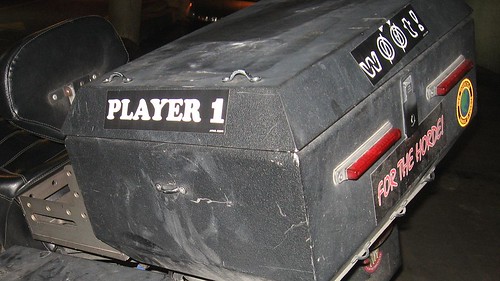
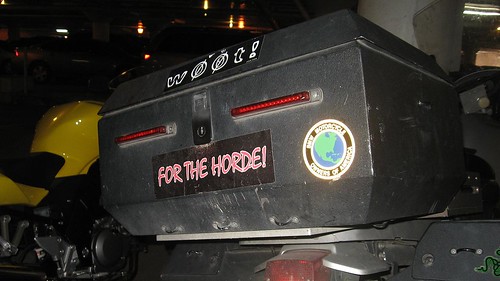
I saw this in my parking garage at work a few days ago. These stickers were adorning some cargo boxes bolted to a nice-looking BMW Motorcycle. Taking a guess, I'd say this guy takes his games pretty seriously. 
My wife tells me "For the Horde!" is a World Of Warcraft reference. She plays it, I do not. Yet.
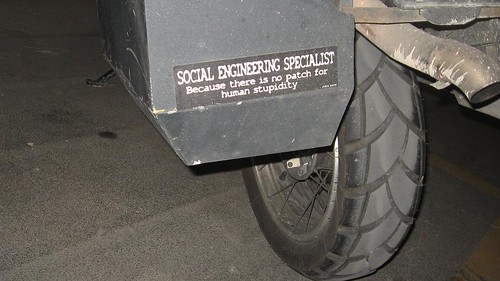
I particularly got a kick out of this one. 
Labels: games, humor, transportation
2008-02-07
Exploiting Online Games
Kansas City native game hacker, tinkerer and developer Josh Kriegshauser discussed Greg Hoglund and Gary McGraw's book, Exploiting Online Games. Josh is an old friend, former co-worker, and former classmate to various HiR writers. He went from tinkering with Ultima Online while he was in school, to being a big name in the MMO industry in the last decade.