2010-03-11

Teaser: Cory Doctorow's new novel, For The Win

It was an odd bit of coincidence this morning. Frogman had shared a story with me from Boing Boing: 200 advance-release promo copies of Cory Doctorow's newest novel, For The Win, are being given away to teenage gamers to review. I should mention that I am thankful to have a few friends who skim Boing Boing for the really awesome and interesting stuff. There's far too much content for me to wade through in my RSS reader, so folks like Frogman are my Boing Boing filter.


Thinking back to an email conversation I had with Cory back in late November (in which I requested a preview copy for HiR), I was wondering if we were going to actually get one of the them. Not 5 minutes later, UPS knocked on my door and dropped off a special package:

At any rate, we're excited to be able to get a sneak peek of Cory's latest work. Frogman will be doing the review. Look for it in the coming weeks!

The end of an era: SecurityFocus

SecurityFocus announced in a memo yesterday that it would, for the most part, cease operations.


It is survived by Bugtraq (which SecurityFocus picked up more than a decade ago) and a few other high-volume mailing lists. In turn, SecurityFocus was picked up by Symantec in 2002. This is a sad day, indeed.

2010-03-06

Ye-olde tech: Slide Rule

Even though this virtual slide rule is full of actual win, you can buy a real (if chintzy) slide rule for cheap from ThinkGeek.


I suck at math, and I'll readily admit it. You still need to be okay at math to use a slide rule: namely, you have to keep track of the order of magnitude of your calculations in your head or on paper. It's no secret that I dig old tech, though. Plus, analog calculators are fun and you can't exactly stuff a Babbage difference engine into your pocket.


Related: Upgrade!

2010-03-01

0x0d - Happy Birthday, HiR!

HiR ca. Late 1997

March 1st, 1997. That's the day I uploaded the first volume of HiR e-Zine (then called "Hackers Information Report") to a few local BBSes. This included pushing it out to a small inter-BBS forum with world-wide reach, and finding its way onto some "hacking" web sites within a matter of weeks.

The first issue was penned by me alone, and almost entirely on a road-trip with my parents, on my old NEC Versa 550D while sitting in the back seat of a powder-blue 1989 Ford Aerostar for hours on end. I was just a kid. Going back and reading some of my older stuff is sometimes embarrassing.

A few months later, I had friends from local BBSes submitting content - Frogman being one of them. Soon thereafter, I'd run into a reader of HiR in a college class -- Asmodian X, who also had plenty of fascinating things to add. Contributors came and went, and I'd answer some e-mail questions. I still keep in touch with some of the past contributors and commenters.

From 2001-2007, HiR faded in and out and was mostly dormant. I got busy. We all got busy. The core contributors all grew up, in one way or another. We'd come up with one or two interesting articles, and think maybe we should put together a new "issue" of HiR.

Even though we all live fairly close, that never happened.

In early 2007, we decided to go with a "blog" format. I think it works better. We write when we get a chance, and the comments section gets us closer to our readers. We changed the name, mostly to shed the "hacker" from our name -- I think most of us have long given up hope of completely reclaiming "hacker" as a good word in all use cases. Now it's just a recursive acronym: HiR Information Report. Why the lower-case i? Partially to encourage HiR to be spelled (like H. i. R.) and partially as a throwback to the uBiQuiToUS LoWeRVoWeLiNG of the 1990s. Can we leave that part behind us?

Some months, we really hammer out the content and muster up a post nearly every single day. Other months, we're all but silent. We're still busy, but we are still passionate. Also, in the last year, we've had a pair of really great guest posts. We hope to have more of these, and maybe even land a few more regular contributors.

At any rate, this is me saying "thanks" to those who've contributed to our journey, on behalf of the entire HiR crew. The co-writers. The guest posters. The commenters. The friends who have been around with us for what seems like an eternity in Internet years -- tossing us link-love even back in the 90s. (Lookin' at you, HNNCast), the folks who still archive our mess of old text files (yes you can find us there, no I'm not linking to it), the folks who have kicked it with us at meetups, cons and user groups. And, of course, the readers, without whom we'd probably have given up on this little project long ago.

2010-02-26

Risk Assessment: Electronic Lock Impressioner

I've kept kind of quiet about this wonderful device. It's an electronic lock impressioner.

Barry Wels talks about the possible mode of operation on his excellent Blackbag blog. I kind of assumed that's how it worked, since it claimed to work only on Ford locks for the time being.

Meanwhile, people are freaking out, labeling it "a car thief's wet-dream."

While I could agree that this device has some potential value to nefarious ne'er-do-wells, there's a fatal flaw in the media panic: You can't steal a car by impressioning the lock.

This device will give you a series of numbers, known as a key code. If you told me the key code to a car right now, I'd honestly have no clue what that key should look like. I could look it up on the Internet, probably. But then I'd need to get out my dremel, a file, a key blank and my digital calipers. If I had a cheap key-milling machine, it might save me a little bit of time. If I spent several thousand dollars, I could get a computer-controlled machine that would simply spit out a key with the right cuts. If I was convincing enough, I *MAY* be able to trick a professional locksmith to cut a key exactly to a code, but most of them would be hesitant to do this without seeing an original key, even if it was a badly damaged one.

The barrier to entry here isn't exactly high, but it's not like you can simply insert this tool into a car door and immediately drive off with it. It's going to take quite a bit of effort or a pricey initial investment for this tool to pay off. The initial investment has already been made by licensed locksmiths who already have these tools laying around. J. Random Carthief, however, probably does not. A successful auto-theft ring MAY have these tools at their disposal. As we already know: if you're being targeted by a sophisticated attacker, it's game over. They'd probably just tow your car away, repo-man style, and break it down at a chop shop.

Let's just assume for the sake of argument that you used this device to get the key code for the car's door, and spent the time to fabricate or acquire a matching key. That's a lot of hassle, but now you can open the car's door, maybe its trunk and glove box. You could even put the key in the ignition. But you couldn't steal the car. Let me explain.

This is my car. I got it a decade ago. Do you like my license plates?

At of the time of purchase, Ford (and many other manufacturers) had already been using two-factor authentication of some variety behind the scenes for years to activate the ignition system. Long gone are the days of pulling a bundle of wires out of the steering column and touching some wires together to start the car, as are the days of simply getting a copy of the car key.

Inside many keys, there's an RFID module or some other device that's somewhat unique to the key. On snazzier cars, this is an encrypted challenge/response module that can't be easily copied. On others, it's a small handful of static "signatures" which may be easy to clone with an RFID programmer or other specialized tools. Either way, without the proper code, the car won't start. In fact, if this module is missing or un-recognized, the car will often completely disable its Engine Control Unit for a period of time, usually 10 minutes.
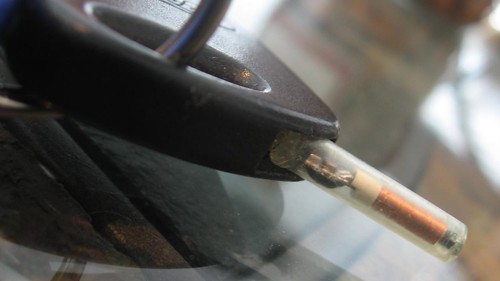
To provide a further layer of complexity to the issue, the end-user must provide proof of owning two separate keys in order to authorize new keys to start the car. In my case, if I had two keys and lost one, I would need the dealership or a high-end locksmith to attach a special computer to my car in order to authorize a new key. That keeps the valet guy from copying your key and activating it himself. Typically, these systems require the programmer to stay connected to the car for a period of one hour before new keys can be added. Even a miscreant would need unfettered access to your car for a whole hour in order to configure a key that works.

In short, the Electronic Lock Impressioner would give a bad guy the ability to make a key that allowed him to steal the stuff in your car, and nothing else. That person would be much better off shattering your window with a brick. In the hands of a good locksmith who has all the proper tools and skill to create a key from a key code and re-program your car's ignition system, this tool should save many hours that would otherwise be spent replacing or re-keying locks. This savings will ultimately be passed on to the customer. In my opinion, this is a revolutionary device that provides benefits to the locksmith industry as well as people who need to use their services. It does so without providing much incentive to car thieves.


2010-02-22

Teaching curiosity

A theme that commonly comes up among security professionals and hackers:


"Is it possible to teach the curiosity that's so important to this field?"

"Can you really teach someone how to be a hacker?"

And so on. I'm usually of the opinion that curiosity is somewhat intrinsic, and that some people are just born curious, or at least their natural curiosity wasn't stifled by oppressive and over-protective child-rearing techniques. But the more I think about it, the more I believe that people can become good at it later on in life if that's what they want to do.

I was interviewed by a student today who was asking what skills one needs for my career. Hands down, the most important skill I have is Critical Thinking. Most of us use a derivative of the Scientific Method when tinkering, whether we acknowledge it as such or not. Being able to clearly communicate the results of our research is also very important.

So, to those of you who are still in school or who are thinking of going back to school, I would suggest that the following classes will help you sharpen your skills in realms that will come in handy for most analytical careers, especially in information security, programming, and systems administration:

Philosophy:
  • Logic and Critical Thinking
English
  • Research Skills
  • Technical writing
Speech:
  • Public Speaking
  • Elementary Debate
Science:
  • Any introductory course that provide hands-on lab time to learn the Scientific Method
There may be pre-requisites for some of these, or the need to pass an appropriate placement test, but the above courses would likely fit into any degree program you're considering, even if they go above and beyond the basic requirements for the degree. These will provide valuable skills to help you in your career path. Even if you didn't grow up with an intrinsically inquisitive nature, I believe that pretty much everyone is capable of "learning how to be curious."

Thoughts? Any other suggestions? Were there some other non-IT courses that provided you with tools you use daily?

2010-02-21

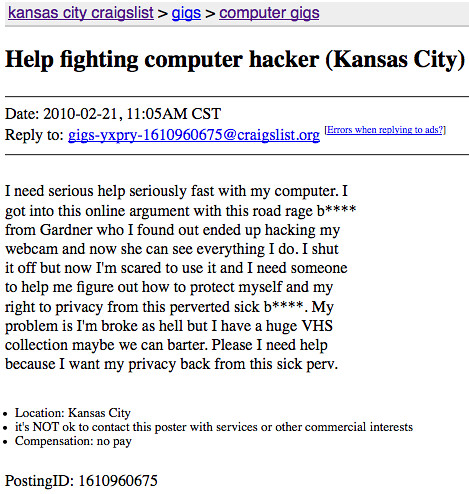
Nominated for Best Of Craigslist


Someone want to help him out? You could get a whole bunch of VHS tapes. Hahah.

I'll pass.