2008-12-31

Zune doesn't like leap years

GenesisWave pointed this out on the Cowtown Computer Congress mailing list.


Q: Why did this occur at precisely 12:01 a.m. on December 31, 2008?

There is a bug in the internal clock driver causing the 30GB device to improperly handle the last day of a leap year.


What a riot. Well, your Zune will work tomorrow. In the meantime, check out i-Hacked.com's Zune Fix. They had the first working walk-through I saw.

Happy GNU Year! (ASCII art edition)


  ╔══╦══╦══╦══╗
  ╚═╗║╔╗║╔╗║╔╗║
  ╔═╝║║║║║║║╚╝║
  ║╔═╣║║║║║╠═╗║
  ║╚═╣╚╝║╚╝╠═╝║
  ╚══╩══╩══╩══╝


¤ø„¸¨°º¤ø„¸ ¸„ø¤º°¨¸„ø¤º°¨
¨°º¤ø„¸ HAPPY ¸„ø¤º°¨
¸„ø¤º°¨ GNU YEAR``°º¤ø„¸
¸„ø¤º ¸„ø¤º°¨ ¤ø„¸¨°º¤ø„

Props to Vikas for the ASCII art

2008-12-30

Open Letter from Geeks to IT Recruiters and Hiring Managers

Preface: No, I'm not looking for a job, although I do get the occasional ping from headhunters. I've seen it before, and my friends (some currently unemployed) are seeing it still. My own boss is actually doing pretty good with the below tips.


For the love of all things good in the world, learn how to hire and employ a geek. You're doing it wrong.

Office Politics
Try to measure productivity in output, not in hours.

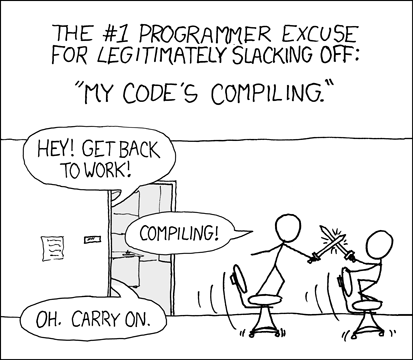
Geeks automate. Geeks script. Geeks compile. They summon computing power to get things done quickly on their behalf. If your geek seemingly spends all day on Twitter and Fark but somehow manages to still complete tasks ahead of schedule, your geek is multi-tasking. This is normal.


Assign tasks to the geeks who are most interested in them, not the ones with the most experience.

When geeks are interested, they are passionate. When they're passionate, they learn fast. You'll get more productivity out of an interested geek with no prior experience than you will with a bored drone who's been doing the same thing for the past five years. Sometimes, the one with the most experience is the one that's most interested. In those cases, you are a lucky manager!


Segregate the corporate, compensatory hierarchy from the leadership hierarchy.
With a team of geeks under you, one or more will eventually become to go-to guy (or girl) for certain things. You don't usually need to assign a "team lead" - Through meritocracy, the Alpha Geek will emerge. That Alpha Geek may lack seniority, but will have the most influence. It's best to let this occur naturally. It's awkward when the one who best fits the role has to answer to someone else just because they've been around longer. Furthermore, the members of your team will still go to the Alpha Geek because the wrong person has the "Team Lead" label. As Paul Glen puts it: Geeks don't hate hierarchy. They hate your hierarchy.

You'll know you've found the Alpha Geek when you see people from your team (and likely other teams) at said geek's desk getting advice or validation on a frequent basis.


Pre-hiring and interview

Have all screening and profile "paperwork" in one comprehensive online wizard or form.
Geeks do not like pens, pencils, or clip boards. We also despise giving you the same piece of information more than once on fifteen different sheets of paper. We'd rather not be sitting on an uncomfortable chair in a room that's far too brightly lit just so that we can give you the information that you want. It's easy to get the information to you electronically.

Only ask for information you need to make a hiring decision.
W2's, Direct deposit information, full fingerprints, home address and all that crap can be handled during orientation. The only personally identifiable information you need before hiring is a name.

Don't grill us on our resume and work history.
You don't hire a geek for what he or she did two years ago. You hire them for what they will be able to do for you now and in the future. Ask your geek to describe scenarios where problems arose that required them to pick up a new skill set to solve. All geeks worth their salt have stories like that and love telling them.


Instead of asking about skills that qualify them for the position, ask about their interest in the kind of work they think they'll be doing.
Remember: Interested geeks work harder. The above requirement will still let you H.R. types ask that oh-so-predictable question: "What is it that you think this company does?" while offering your candidate a chance to really show he or she will be a good match.

Recommended Reading

I saw Paul Glen speak at IT Security World 2008, and his book, Leading Geeks has a lot more sage advice for those who find themselves leading a technical team.

2008-12-29

Bruce Schneier gave me a puzzle to solve...


I won this from a contest BT Counterpane hosted.

The "code" is simple:

OHOE
OEYN
KBTJ


I will, Bruce. I will.

Full HiR Reading Room review coming after I finish reading it.

2008-12-28

Cracking Master Thumb-Wheel Padlocks

While on a bike ride today, I found this on the roadside:


It's a Master 175, as stamped into the bottom plate shown below. There are many locks in this series, including shrouded hasp models (177 series) and black coated ones (178 series). Internally, they're all identical. The only thing different is the color and the length of the hasp. Most people know that Master's cheap dial-combination locks are vulnerable to a variety of attacks. These are sold as "construction grade" locks. I figured I could put it to use if I could get the combination. I didn't feel like breaking it apart.


Tension probing
Many thumb-wheel combination locks like this (including the ones you see built-into attache briefcases) have a weakness that allows you to determine the combination by feel. You pull on the hasp or otherwise try to open the lock while spinning the wheels until you find one that is hard to turn. Turn it until it feels like it snaps into place. Move on to the next wheel that is binding, and work your way through them until the hasp opens.

The Master 17x locks don't suffer this vulnerability. Being "construction grade", I suppose that's a good thing. To open the lock, you must enter the right combination, then push the hasp in. If the combination is correct, it will pop all the way out and open. If it's not correct, it'll just retract to its locked position. This makes brute force attacks exponentially more difficult.

Bypass
Another vulnerability with some thumb-wheel locks is a nifty bypass method. If you can trigger the hasp release without entering the combination at all, it'll open for you. This is usually done by wiggling some metal around the thumb wheels to probe the inner mechanics of the lock, then attempt to release the hasp that way. While that's good and well, I want to know the combination so that I can use it. Open or closed, this doesn't do me much good.

Cam probing
This is what I'm interested in. Each wheel has a cam attached to it. These cams have dimples, flat spots or notches which allow the gate to drop into place when the correct combination is entered. As the wheels' clearance between the metal bottom plate is pretty tight, I've opted to use a thin feeler gauge, made for rebuilding automobile engines. These tools are cheap, cheap. I think this one cost me $4 at AutoZone.


Each of these blades varies in thickness. The number on top is in thousandths of an inch, and the number below is in thousandths of millimeters. I found that the .0015" was simply too flimsy (it's about as thick as a sheet of aluminum foil, but made of steel and much stronger), so I went with the .002".

I had to do some tinkering. For starters, I didn't know which side of the wheel to probe, so I started with the left side. There's a ridge around the thumbwheel that keeps the feeler from going in more than 1/10" or so. I wiggled it around and eventually got it in between the metal plate and the thumbwheel, and inserted as far as it would go. Then, I started carefully turning the wheel while gently pressing the feeler inward. This promptly got me nowhere. I couldn't feel anything happening at all.

I moved to the right side of the thumbwheel, and I had it! I still had to weasel in around the ridge of the thumbwheel, though.

Note that the feeler is not sticking in very far. You can see the rounded edges of the feeler.


While turning the wheel, the feeler dropped noticably into place (in the middle of 2-3 on the 3rd wheel as shown), and I could feel it getting pushed back out if I tried to spin the wheel further.


Note the peculiar location of the flat spot on the cam. It's between two numbers on this model. That will help us in a moment.

Find all of the flat spots and jot them down, in my case, it was:
5/6, 7/8, 2/3 and 5/6

In this position, it shouldn't surprise you that my lock didn't open.

The gate is usually 90 degrees or 180 degrees from the wheel alignment mark. That means it's either directly opposite the alignment mark, directly above the wheels, or directly below them. Given that the flat spots were between two numbers, this rules out the gate being opposite the alignment mark. Turning the wheels 180 degrees would land them at: 0/1, 1/2, 7/8, and 0/1, which isn't really a combination Master had in mind.

I chose to rotate all of them 90 degrees upward, toward the lower numbers. Starting with the dials at the position you wrote down:


Nudge all four dials upward to the number that sat below the alignment mark


Then move all four dials upward two more spots (decreasing numbers unless you start at 0)


Press the hasp in, and it opens!

Similar methods work on a large number of locks. You just have to tinker. Now you know how almost all thumb-wheel padlocks work!

In Review
The instructions for cracking a lost/forgotten/unknown combination on a Master 17x series thumb-wheel padlock:

  • Hold the lock with the bottom plate facing you and the numbers right-side up.
  • Use a feeler gauge (I used .002") between the right side of the thumbwheel and plate.
  • Carefully turn the thumbwheel while applying gentle pressure on the feeler gauge.
  • Write down where the feeler sinks into the lock deeper. It will always be between two numbers on 17x locks.
  • Turn all four wheels to the locations you wrote down.
  • Turn all four wheels upward to the number on the bottom of the split.
  • Turn all four wheels upward two more whole numbers.
  • Press hasp in to open
Once you've done this a few times, it can be repeated in just a few minutes. The first time through took me about 15 minutes or so, because I didn't know for sure which side of the wheel to probe nor which direction to turn the wheels to activate the gate. I repeated the process for the photo shoot. Before I wrote this article, I tried it again after changing the combination on the lock, and it took me only 3 minutes.

2008-12-27

You're Doing It Wrong: Whiteboard Security

Smart whiteboards can take what's drawn on them and print them, store them, e-mail them and a whole variety of other fun things. Panasonic is bringing password protection to these features.  [Via Engadget]


Darren Murph (whose snarky writing style I enjoy) says:
...The film and steel boards look pretty traditional at first glance, but underneath of that plain jane facade is a highly advanced security system. You see, each board can accept passwords, which will in turn restrict the ability to transfer information from the board to USB flash memory. For those cleared for access, the whiteboards can transfer on-screen information to a PC via USB, though we suspect you'll have to handle the encryption on your end. 'Course, neither of these will run you cheap, but you know your underground supervisor won't mind shelling out upwards of two large to make sure schematics to rule the world aren't intercepted by meddling rivals.
of course, you can practically hear read the sarcasm.  This is like putting a bank vault door on a 4-foot-tall chain link fence. There's little to keep someone from snapping photos of the whiteboard with a camera phone, or from sketching along with the presentation while stuff is being drawn.

Security. You're doing it wrong.

2008-12-25

RepRap


[Photo via Hack A Day]


I've been watching RepRap for a while.  I was reminded of it by a recent post on Hack A Day which focused on the new revision of the RepRap Motherboard. The project is self-described:
A universal constructor is a machine that can replicate itself and - in addition - make other industrial products. Such a machine would have a number of interesting characteristics, such as being subject to Darwinian evolution, increasing in number exponentially, and being extremely low-cost.

A rapid prototyper is a machine that can manufacture objects directly (usually, though not necessarily, in plastic) under the control of a computer.

The RepRap project is working towards creating a universal constructor by using rapid prototyping, and then giving the results away free under the GNU General Public Licence to allow other investigators to work on the same idea. We are trying to prove the hypothesis: Rapid prototyping and direct writing technologies are sufficiently versatile to allow them to be used to make a von Neumann Universal Constructor.

All good projects have a slogan, and the best have a slogan that reeks of hubris. RepRap is no exception. Our slogan is:

"Wealth without money..."
Impressive as the project and it's goals are, I personally find the miniature-advances in technology being made by the RepRap guys more inspiring than the RepRap itself. The Hack A Day post focused on the motherboard, which is based on the Sanguino platform. This new platform came out of RepRap's need for more functionality than the Arduino could deliver, and is a perfect example of hackers encountering a problem that would normally shut down or severely hinder a project. Then, not only did they find an intuitive way around it that was very useful for many other projects beyond the one that necessitated it, but they gave the solution back to the community as well.

That, my friends, is the spirit of the hacker.