
Frogman and I talked about Retro Computing for the CCCKC Grand Opening. Ours was more of a demonstration, but we did hit quite a few points worth noting. We didn't have slides for the demonstration, but we threw these together today.
Operating Systems:
Puppy Linux
Damn Small Linux
TinyCore Linux
NetBSD
OpenBSD
Install Tools:
Smart Boot Manager
UNetbootin
Thin Client Software:
RDesktop (RDP Client for Linux/BSD)
TightVNC
Text-Mode Applications:
Links Web Browser
Finch (Part of Pidgin IM Client)
Midnight Commander File Manager
StarTTY Text-mode information service
Showing posts with label jornada. Show all posts
Showing posts with label jornada. Show all posts
2009-03-07
Retro-Computing Presentation and notes

2008-04-11
JLime Linux - WiFi Scanning, New Userland, etc...
Almost all of the problems I was initially having with jlime were due to the fact that when I downloaded it, they were in the middle of a big update with an experimental kernel and an old base userland image. After pulling down the new userland and going to a known-stable kernel, everything seems to be rockin' and rollin' with jLime on my Hewlett Packard Jornada 720.
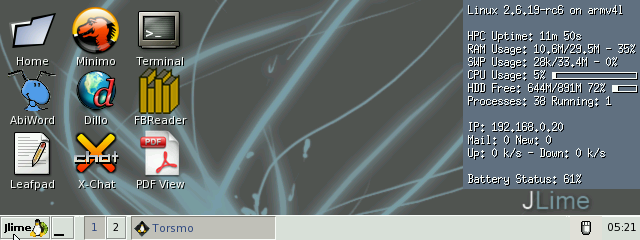
Case and point, X now has a decent interface, desktop icons, and Torsmo status monitor works great (finally!)
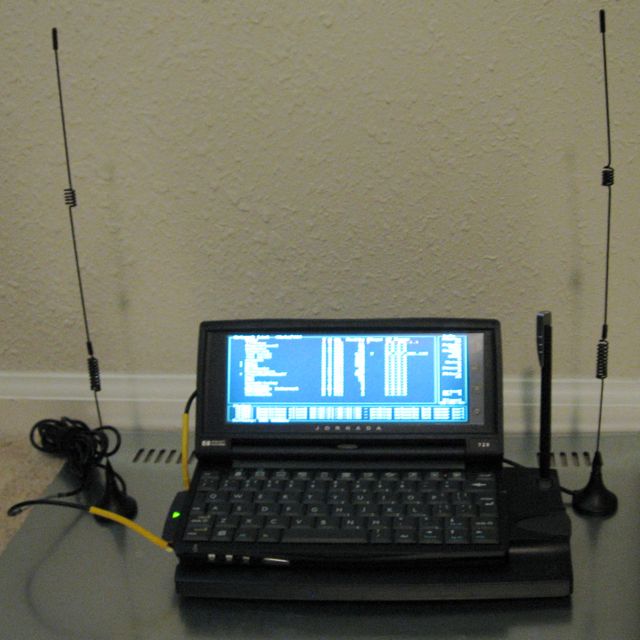
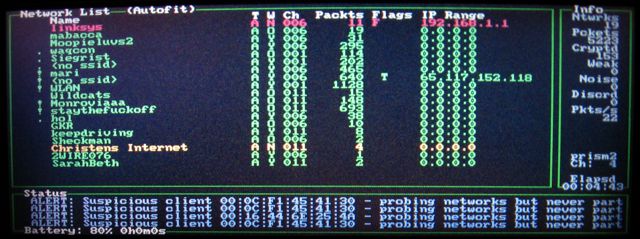
I was also having problems with package management. Those were also resolved by installing fresh from the current userland image. The packages are also pretty up-to-date with a quite extensive list of things to choose from. Want nmap? MySQL? OpenSSH? No problem! Kismet for War-driving? Just say the word! Here's my J720 running Kismet with a Senao Engenius 200mW Long-range 802.11b card attached to a pair of 19dBi omni-directional magnet mount antennae.
And a close-up of the screen:
All this, and my battery lasts for hours upon hours, even with the wireless card installed. I actually have nothing left to complain about at all aside from the fact that 32MB of RAM and 206 MHz is still a somewhat anemic machine for web browsing. For light-weight stuff like checking e-mail, managing servers via SSH and the like, this seems to be just about the most handy thing I've seen in a very long time.
I'm working on getting a data cable for my new GPS so that I can really put this thing to the test when it comes to war-driving. I haven't ever used kismet for serious network location. I'm more of a Mac OS X and BSD guy at heart, so KisMAC and BSD-Airtools are my typical weapons of choice.
It's simply amazing to me, though, to see this kind of development happening for a family of portable computers that's been more or less dead for the better part of a decade. Where I was once drooling over the OLPC and EEePC, I'm now finding that I have all of the ultra-mobile goodness I really need right here in a package that's admittedly slower but also lighter, smaller and longer lasting.
2008-04-06
Trying this... Posting from jlime
Thanks to a tip from a jlime forum denizen, I found out that an older kernel would work better on my Jornada 720. Suspend works, WiFi works, even the Torsmo status app works better. Minimo didn't like Blogger, but the Dillo browser seems to be working albeit in a really minimalistic way like you'd expect in a phone's browser.
In short, this is actually a completely functional networked Linux PDA right now. I'll keep this around and do some periodic reviews as I further use this platform.
2008-04-05
UNIX variants on HP Jornada Palmtops
We covered this a bit at the 2600 meeting last night. I don't have a lot of time to go into detail, but here's a quick breakdown.
Asmodian X got me hooked on Windows CE Palmtops back in late 1997. I picked up a floor model HP 300LX for cheap, and actually used it as my main computer (including Dialup BBS, Telnet, Mail, and web browsing) for quite a while. It was more than sufficient for typing my papers for class and interfacing with the UNIX servers. Asmo also had a Casio Cassiopeia running CE, so we tinkered with this stuff a LOT back in the day.
Later, at DefCon 6, we'd run into a guy with an HP 620LX. That thing had a full color screen and a significant boost in memory, not to mention sound recording ability. This all sounds cheesy now, but it blew away the devices we had with their four or 16-color greyscale screens.
As time has progressed, I've also acquired an HP 320LX (same as 300LX but with a backlit screen and more RAM), a Jornada 680e (Refurbished Dutch Railways model) and a Jornada 720.
The HP300's are currently packed away somewhere, but the Jornadas are alive and well.
I was considering NetBSD and Linux for this project, but I found out that the NetBSD project for these pretty much died once they could say "it boots!" You have to use a serial cable for the console. In other words, it's useless until someone ports wscons and some device drivers. So, I chose JLime Linux, which is still in active development -- the kernel build on my 720 (Mongo branch) is less than two weeks old!
To install JLime, you need a CF card that's at least 128MB. You create 3 partitions:
- FAT partition usable from within Windows CE
- ext2 partition for Linux to run from
- Swap partition for virtual memory
Once you insert the card into the PDA and run the boot loader, all of the PDA's memory will be completely wiped, so all files and data on it will be lost. Windows CE stays in ROM so when you reboot, Windows CE will be back in initial setup mode.
I actually put the boot loaders and zimages for both the J680e and the J720 on the FAT partition, created two different ext2 partitions, and left one shared swap partition on my 2GB CF card. Had I been thinking, I would have made a third ext2 for a shared home directory between the two PDAs.
Right now, here's the status of them:
Jornada 680 running jLime (Donkey):
- Boots Linux, loads fine.
- The keymap is completely trashed (dutch keyboard layout) so I can't login.
- Apparently, the J680 can "suspend" while running jLime.
- Boots Linux
- Runs X with IceWM
- Various X Apps work fine (MiniMO Browser, aterm, etc)
- Recognizes PCMCIA Ethernet and 802.11b/g wireless cards
- Can't seem to use the network, even when configured properly (dhcp doesn't get an address, wireless cards can't associate to open, unencrypted networks, etc)
- Cannot go into suspend mode properly. The backlight stays on, limiting battery life.
- After halting, the PDA can't reboot without a hard reset (removal of main and backup battery at the same time)
Subscribe to:
Posts (Atom)

 Posts
Posts


