

It started as a simple trip to the hardware store. My mission was to find some 3/8" threadrod at 24 threads per inch. I was going to chop it with my dremel to a length of 6 and 9/32 inches long and use it as a 1/4 wavelength antenna in a mount similar to the one shown above. What I found were many kinds of threadrod, but nothing that would screw into either of my antenna bases.
I opted for a piece of 3/8" smooth rod without threads, figuring I could just wander over to the hardware store's selection of threading dies and pick up the one I needed to cut a dozen or so threads into the rod. There, I found many dies, but not the 3/8" x 24 I needed for the project. There was a spot for the die I needed, but it was empty.
I finally cornered a sales associate, who looked up the part number, said they had one in stock, and even scoured the shelves looking to see if someone had placed it in the wrong spot. What happened next took me by surprise. The associate went around to the back shop, pulled a full set of dies out of the tool chest, found the one I needed, and brought me around to the vise and tossed me some cutting oil and gloves so I could tap threads onto the rod myself. While I was working away, curiosity got the best of him. "What are you building?" he asked. I explained that I was building a very cheap antenna, and explained that I was going to take it home and cut it to length so that it resonated at about 448 MHz. That's about the time he took me over to the chop saw with a cutoff wheel and a bench grinder. He found a couple pair of goggles and we got to work.
So there you have it. I walked in, spent a few bucks on a steel rod, got about 20 minutes of free shop time and left with a finished product. Westlake, you're like having a hackerspace a mile from home!
2012-07-24
Westlake Hardware: My hackerspace?
2009-12-01
Rant: Hackerspaces do not foster cybercrime!
Two things pissing me off today. First: Vitriolic and audacious comments on this otherwise awesome article about hackerspaces in STL Today. Some excerpts from the comments:
The authorities need to keep a close watch on these people. Perhaps their source of funding will be hacking bank accounts.
Trying to include teenagers can get complicated. Personally, I feel open access to tools for cyber hacking, learning how to steal passwords, and other mischief can be inappropriate at that age. Even university students get caught up trying to make a name for themselves. [ . . . ] I was a founding member of CCCKC but these are reasons I chose to leave the group. I don't want to be labeled a cyber hacker by association.
Fortunately, there's some sanity and fact-checking in the comments, too.
And then there's news about Forskningsavd (a Swedish hackerspace) getting raided for something completely unrelated to the hackerspace. Further, the seizure of property seems completely bizarre given the stated reason for police intervention.
So, I'm feeling ranty. Here's some background on how my local hackerspace deals with "Cyber hacking and other mischief"
Shortly after CCCKC's grand opening, a series of courses were taught on cyber-security. These four sessions were very popular, covering the basics such as understanding the difference between hubs and switches, and eventually covering powerful tools such as nmap, Hamster & Ferret, Metasploit, and Maltego. The courses provided enough demonstration to scare people into being more cautious while teaching them how to avoid being victimized. Nothing was covered that hasn't been hashed over online a thousand times already, but it was very cool to get a guided tour through the maze of cyber-security and to be able to tinker around in a hands-on lab environment.
Around the same time, locksport also took off. A solid-core door got drilled out, had eye-screws put into it, and became a standing board of different locks to play with. The Lock Picks & BBQ series was also a big hit. People would come out, grill some meat, and then learn about the mechanics of simple locks.
Critical thinkers absolutely love to explore dynamic boundaries, and very few boundaries are as controversial and exciting as the enigmatic balance of attack resistance vs. usability in both physical security (locks and surveillance) and information security (firewalls, encryption and vulnerability exploitation). It's no wonder some of the worlds most intelligent people have dabbled in security. Richard Feynman, for example, picked locks at Los Alamos for fun and pranks.
Now, several hackerspaces are uniting with an international VPN that's going to be much like a digital Capture The Flag game. We're calling this effort "The Warzone Project" and it'll give people a safe, isolated environment to practice their skills in information security systems.
The thing is, there's already a lot of very detailed information on the web and in books when it comes to breaking all kinds of security systems. Demonstrating them in a lab environment gives people a safe place to "get it out of their system" much like Grudge Night at the local drag strip gives teenagers a safe place to race their cars so they aren't endangering people on public roads. The lab environment also allows people to legally learn about more aspects than they could in their own homes, and to take a shot at mastery in defense by understanding both sides of an attack.
"Hackerspaces are about learning, sharing and collaboration."Folks, every hackerspace takes on a personality of its own based on what the members are interested in. Some hackerspaces focus on electronics or take an art, metal/woodworking and maker approach. Some tend to focus on programming microcontrollers or building robots. Others are busy tackling so many eclectic projects that they don't even have a core focus. They all have some things in common, though: Hackerspaces are about learning, sharing and collaboration.
Writing the code and creating the control infrastructure for a botnet takes dedication and lots of work. Poring through source code, looking for bugs and creating a working exploit is no small feat. It can take years to fully master exactly how locks work and how to manipulate the parts inside. Indeed, learning in a lab environment teaches patience. It teaches respect for the systems. Learning is hard, but it's good for you.
Compare that to the modern criminal reality: Right now, anyone in the world can rent a cadre of botnet computers for just a few dollars and use them to send spam, to host fake bank websites, to obscure their attacks or to use in a massive denial-of-service attack. Anyone can look up the latest zero-day exploits and use them for bad things. Anyone can buy a bump key and start opening about 30% of the locks that key will fit into. Subversion is easy.
If subversion is your goal, you would be silly to waste your time learning all the minutiae of systems from hackerspace denizens. Cyber criminals already know this. Apparently, some people still don't get it.
Update
I thought I'd share a quick list of things we've worked on and had talks about lately at CCCKC:
- Assisting JayDoc, a not-for-profit medical charity for the needy
- Joined more than a dozen hackerspaces live via webcam for the synchronous hackathon.
- Projected a game of Tetris onto a wall in downtown KC
- Building, studying and using the MakerBot
- Ran tech support and helped make BarCampKC 2009 a success
- Built a Twitter-bot (that's currently on the fritz)
- Set up a silk-screen lab for emblazoning logos onto things.
- Got good press in INK KC
- Set up a MIDI music workstation
- Built a compressed air T-shirt cannon
- Got a bunch of people familiarized with Arduino programming
- GPSes, computer interfaces for them, and Geoc... "finding things people hid somewhere"
- Search engine optimization
- Robotics
- Hacking the car-buying process
- Intro to Craps (the casino game)
- Server/telecom racks
- Electronics
- Robotics
- Radio Controlled Toys
- Photography
- Scrapbooking/Crafts
- E-Textiles (like gloves that work with touchscreens, LED embroidery, etc)
2009-10-30
CCCKC: Hack-o-Lanterns revisited
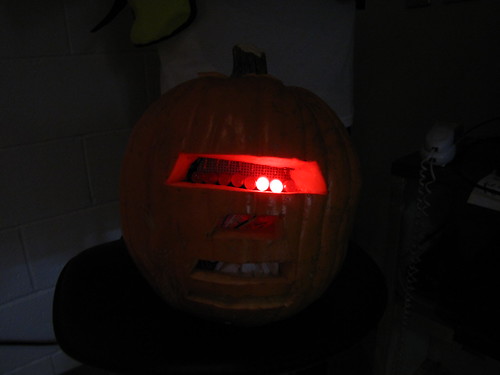
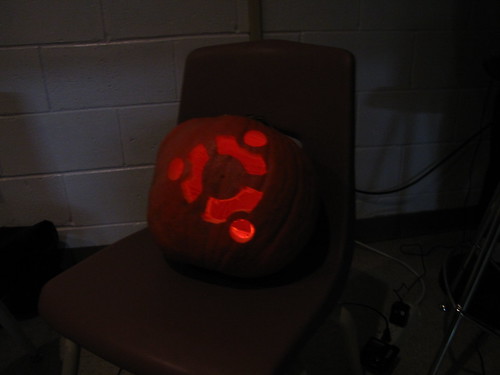
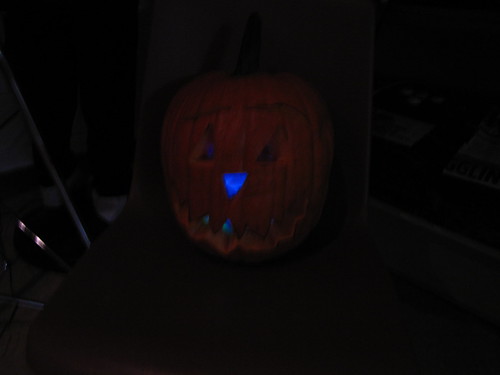
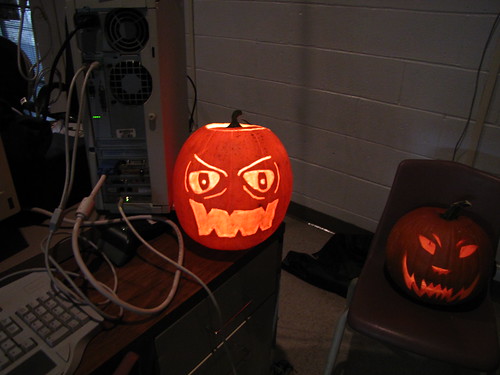
Since I already made my own Life Glider Hack-O-Lantern, I didn't participate, but several people brought pumpkins down to the CCCKC Hackerspace last night to carve out their geeky designs. I left before most of them were completed, but I noticed they showed up in the CCCKC flickr pool this morning. Some of these are pretty nifty! I particularly enjoyed the LED-illuminated Hack-o-Lanterns. Check out that microprocessor-driven Cylon!
There are more geeky jack-o-lanterns over at Geeks Are Sexy. Also: Some tips for hosting a Halloween party.


2009-09-12
Gustav, the hackerspace twitter-bot


- An old 1U Rackmount x86 system I had laying around
- X10 TM751 Transceiver
- X10 CM11A Bi-Directional Serial Interface
- X10 MS13A "Hawkeye" motion sensor

TTY /dev/tty00The HEYUHELPER Script Mode just tells heyu to look for a script in the path called "heyuhelper" and run it. It passes some X10 parameters in the arguments, but for the time being, I am not using them. The above configuration is almost the simplest one you can put together and have a working Heyu install.
HOUSECODE C
SCRIPT_MODE HEYUHELPER
/usr/local/bin/heyu -c /etc/heyu/x10config start
#!/bin/sh
date +%s >> /var/log/motion.log
The final piece of the puzzle is a script: /usr/local/bin/cavecheck.sh, that runs from cron.
#!/bin/sh
curdtme=`date +%s`
lastdtme=`tail -1 /var/log/motion.log`
dif=`expr $curdtme - $lastdtme`

if [ "$dif" -lt 1800 ]
then
if [ ! -e "/var/log/caveactive" ]
then
/usr/local/bin/curl --basic --user "username:somepass" \
-d status="#ccckc: Hackers are in the cave!" \
http://twitter.com/statuses/update.xml
touch /var/log/caveactive
fi
fi

if [ "$dif" -gt 1800 ]
then
if [ -e "/var/log/caveactive" ]
then
/usr/local/bin/curl --basic --user "username:somepass" \
-d status="#ccckc is kinda quiet..." \
http://twitter.com/statuses/update.xml
rm /var/log/caveactive
fi
fi
The cron entry itself is pretty easy. I added this to /var/cron/tabs/root so that it runs once every minute.* * * * * /usr/local/bin/cavecheck.sh

2009-02-26
CCCKC Photo Dump
The space is really coming together, and tonight looked like I expect many nights will look as we prepare to open the space 24/7 for makers, hackers, and tinkerers to collaborate with one another.
It was retro-computing night, apparently. This is my Zenith ZWL-184-97 "SuperSport". It's rocking an upgraded 8087 CPU at 8MHz, a 20MB built-in HDD and a 4-greyscale CGA monitor.
Victor tore into his Apple //e. He feared that the drive had been "eating" disks, so he took to it with Everclear. One drop for the read head. One shot for Victor. Two drops for read head. One, Two shots for Victor. No, he didn't drink it.
The ultimate test: Oregon Trail! Success!
Nekkid Apple pr0n:
Someone put a license plate frame on the plate I donated to the space.
And hevnsnt brought in the LED banner
... then Jestin defaced it...
Billy Crook's Remote-camera robot was a big hit. The camera mounted on the claw transmits audio and video back to the visor being held in the background.
A Robot's eye view:
Arduino hacking
An old rack-mount modem bank, repurposed as an LED display project.
This robot is controlled by an R/C car remote and uses normal (albeit slightly modified) R/C servos. It's designed to fit inside a typical hamster ball and then you can stroll around. Sorry, no camera attached to this one.


2009-02-24
Cowtown Computer Congress Grand Opening [Kansas City]
 The hour draws neigh. On March 2nd, Kansas City's hackerspace will be open for 24/7 access to members. To kick it off, there will be a week full of Grand Opening events. Check the CCCKC Wiki's Grand Opening page for an up-to-the-moment list of what's going on.
Friday, March 6th would traditionally be the 2600 Meeting at Oak Park Mall, but several attendees will be at the CCCKC Opening instead. Further, all of the HiR folks from Kansas City will be giving presentations on interesting topics: Retro-Computing, Moodle: An Open-Source Education Suite, and Hacking La Fonera routers.
Depending on how much of the usual 2600 crew shows up, we may (or may not!) decide to switch the official meeting space to the Cave. After all, it's not far off the highway and it's close to Westport for plenty of post-meeting dining and drinking. Plus, it would be easier to communicate without all the distractions and noise of the mall.
If you're even remotely near Kansas City, it'd probably be worth your time to come out at least to see the talks Friday and maybe stick around for the DJ Bash on Saturday night.
2009-02-05
Fun with Google Sketchup: CCCKC Floorplans
Pretty much from the get-go, I've been ready to help as needed with CCCKC's build-out and design team. On Tuesday, we took a tour of the new space to get a feel for how we'd try to set it up. I went to work creating what I saw in my mind's eye, using Google Sketchup. At this evening's meeting, I went ahead and presented it to the attendees. I got a lot of good input from everyone, and came away with a few really good ideas. There's a lot of work to be done.
Here's a photo from the loading dock entrance (all the parking we can use is above ground, but I walked in through the cave entry this evening)
Here's what I came up with in Sketchup. There are tons of free 3D Models for furniture and appliances. I love it. The space is about 1,400 square feet, and the space is almost a perfect square, divided into four rooms. I was just guessing when I drew the walls into place on Tuesday night, but tonight I confirmed that my guesses were close enough.
The main room will be the primary meeting place for affiliate organizations. I see this room needing a lot of flexibility. This is kind of what the space could look like when you enter. The green wall shown above probably won't work exactly like that. We'll probably try to get a pull-down green screen and a projector screen and mount it near the front of the room.
Easily-moved tables and nesting or folding chairs will be a major bonus here. It can be wide-open for social events, the tables forming an island for user-group meetings, or arranged into classroom-like rows for seminars, for example. From the front of the meeting room, it could look something like this.
The room near the front of the meeting room will be telecom, material storage, and the home of the CCCKC Library: a shared pool of books, manuals, movies, and other media. There will be a full-height telecom rack (not enclosed) and probably a half-height server cage, even though I used a full-size model in this rendering.
The middle room will be the workshop. There will be at least one full-size workbench and a table. This will likely be filled out with things like a band saw, drill press and soldering stations. We might even see about fitting a drafting table in here.
I am envisioning the "kitchen" area being a social hub with at least one sofa, a TV, and definitely some game consoles. It'll be a good place to chill after working on something in the workshop, and maybe a good place to take a nap if you find yourself staying in the hacker cave until the wee hours of the morning working on stuff.
Right now, though, it's just four rooms with some old office furniture.
That brings us to a few important points:
There are some things we already have or that members are already donating: The 2-pot coffee maker, TV, consoles, shelving, the server/telecom racks, fridge and a few old crappy desks.
Things we really need. If you have any of these in Kansas City and feel like donating, we could use this stuff:


- Classroom tables
- Folding or nesting chairs
- Sofa
- Workbench
- Pull-down Green Screen / Projector screen
- Projector
- Also, for the love of all things good, pick up a MacBook raffle ticket - It'll help cover rent and operating expenses for the future. Raffle closes March 1!

 Posts
Posts


